The Cat Flap Was Older Than the Joke
November 2, 2026
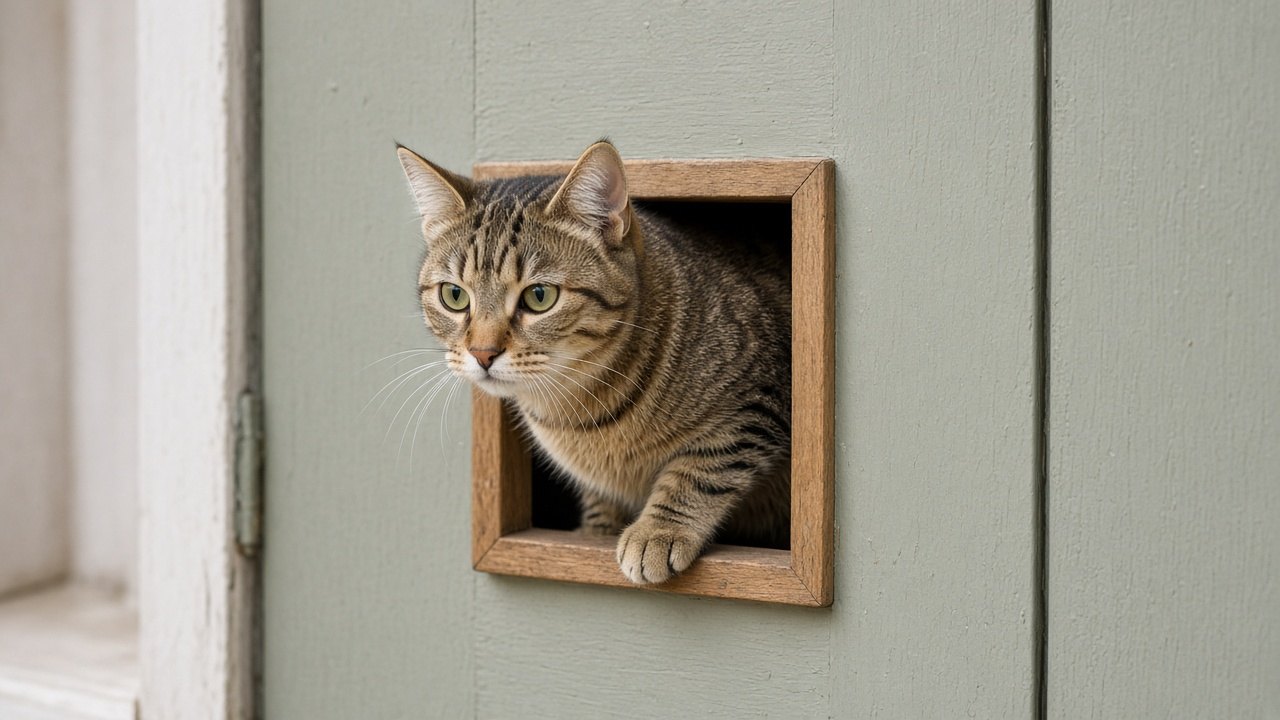
An essay printed in 1802, seventy-five years after Isaac Newton died, is the earliest version anyone has found of the story that he cut two holes in a door, one for a cat and a smaller one for a kitten. The joke was not a compliment. It was an example of an English genius being foolish. The Straight Dope, tracing that essay through a 2011 history of Trinity College, Cambridge, says the writer used Newton to illustrate incompetence: the great man had not realized the kitten would follow the cat through the larger hole.
John M. F. Wright, a mathematician who had been a Trinity scholar, repeated the yarn in an 1827 memoir and added a detail that made it feel like evidence. Whether the account was true or false, he wrote, two plugged holes of the right sizes for a cat and a kitten were still in the door. The Straight Dope's reading of that sentence is the sensible one. Someone saw holes of unknown origin in a door tied to Newton's old rooms, decided they were cat-sized, and built a story to fit them. There is no contemporary record that Newton kept a cat at all.
The modern version of the tale flips the insult into praise. In that telling, Newton was working on light, a cat kept spoiling the darkness by opening the door, and he invented a flap so the experiment could continue. Douglas Adams later put the flattering moral in a novel: an extraordinary mind takes something that did not exist and makes it obvious. The Straight Dope points out what the flattering version leaves out. Even if the holes were Newton's, the early accounts never say he invented the cat door. They say he cut holes, and they say it to laugh at him.
A hole was already old. Geoffrey Chaucer, writing The Miller's Tale in the late fourteenth century, has a servant find "an hole" low in a board, "ther as the cat was wont in for to crepe," and look through it. The Straight Dope's researcher checked the lines in Chaucer rather than taking a summary's word. IFLScience quotes the same passage. A cat hole, in that poem, is ordinary household equipment, something a servant expects to find, more than two centuries before Newton was born.
The cloth flap is a later convenience hung on an older idea. IFLScience notes cat-sized openings in sixteenth-century church doors that were cut for dogs, not cats, which is a reminder that a small door inside a large door is a building habit, not a Cambridge invention. Len Fisher, a scientist who has repeated the Newton story and then withdrawn it, says the tale was invented after blocked holes were noticed at the bottom of a Trinity door, one smaller than the other, and that there is not a shred of proof Newton made them. Fisher is useful here because he is correcting his own earlier claim, not defending a mascot.
What the legend is really about is the way a reputation hardens. While Newton was a recent memory, the two holes made him look ridiculous. Once he had become a symbol of pure intellect, the same holes were recruited as proof that pure intellect also invents the practical thing. Gizmodo's account of that switch matches the Straight Dope's: the joke circulated to show how stupid a smart person could be, and a later audience, wanting the smart person to be smart about everything, kept the holes and dropped the punch line. The cat, in both versions, is a prop. In the first she exposes the genius. In the second she receives his gift. Neither version asks what a fourteenth-century cat was already doing.
The practical history is less flattering to any one name and more useful to anyone who lives with a cat. People have been cutting a low opening in a door, a board, or a church wall for as long as they have wanted an animal to come and go without a person standing up. The flap, the magnet, and the locking panel are refinements. They solve weather, raccoons, and the neighbor's cat. They do not create the idea. When a product page says a brand invented the cat door, the claim is usually about a latch, not about the hole.
There is a second lesson in Wright's plugged holes, if the holes were ever real. A blocked opening is what remains after the reason for the opening is forgotten. A later resident sees two circles, low in the wood, and reaches for the most famous man who slept nearby. Fame is a magnet for unlabelled carpentry. The same thing happens with feeding dishes, worn thresholds, and scratches at a certain height on a door jamb. The house records a cat. The storyteller supplies a genius.
None of this makes a flap a bad idea. A cat who can leave and return without a person opening the door is a cat whose day is not organized around someone else's schedule. The point of the record is narrower. The convenience was not born in a Cambridge experiment about light. It was already a habit in a medieval household, ordinary enough for Chaucer to use it as a place to spy. Newton does not need the credit, and the cat does not need Newton.
If you are cutting an opening, cut one. The kitten follows the cat. That is the part of the 1802 joke that has always been true, and it was true before anyone told it about a mathematician.
Sources
- https://www.straightdope.com/21344247/did-isaac-newton-invent-the-cat-door
- https://www.iflscience.com/the-cat-flap-is-surprisingly-ancient-and-not-the-work-of-isaac-newton-65443
- https://www.lenfisherscience.com/12-newton-and-the-cat-flap/
- https://gizmodo.com/the-legend-of-isaac-newtons-most-foolish-and-cat-frie-511737218
- https://www.cityweekly.net/news/kitty-shack-2374480