Choosing a Scratching Post
November 3, 2026
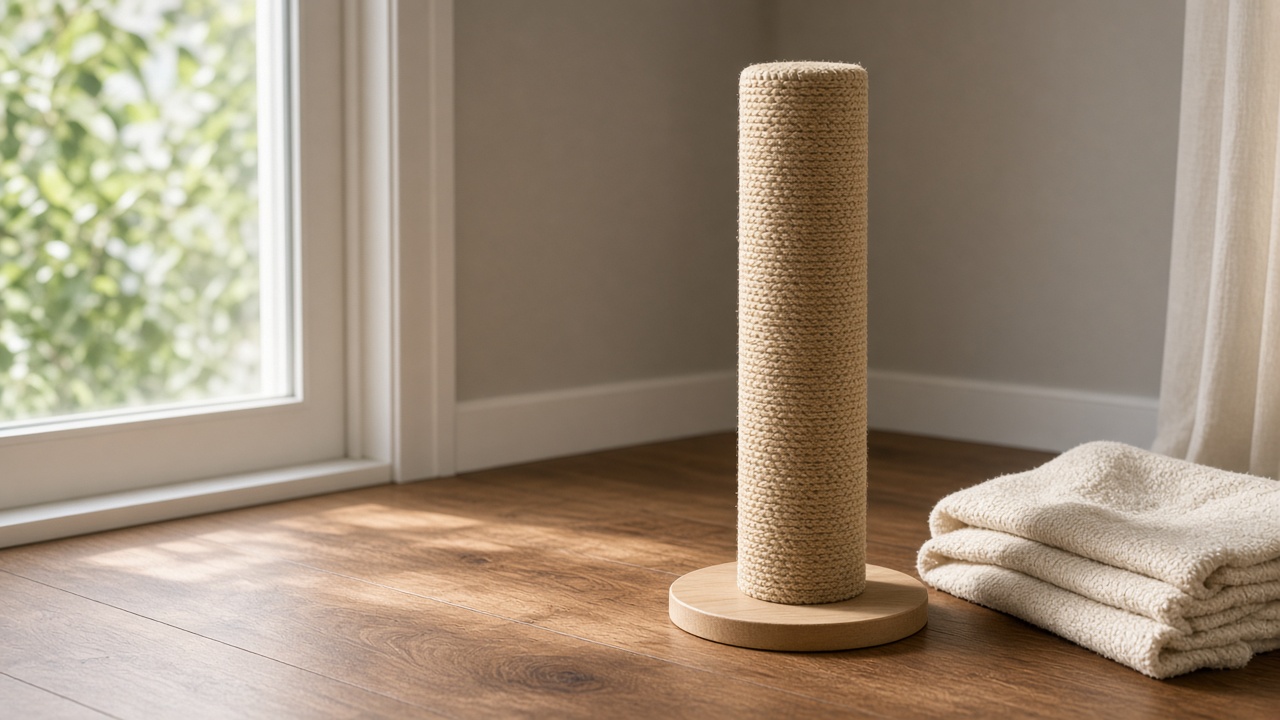
Scratching is not a habit you delete. Cats scratch to shed claw sheaths, to stretch, and to leave a scent mark. Cornell's feline health center compares it to grooming: innate, and hard to stop. You can move it. The post has to be the thing the cat already wanted, only in a place you can live with.
Match the motion you already see
Watch for a week before you choose. A cat who climbs the drapes or the arm of a chair is scratching up and down. That cat wants a tall vertical post, the kind that can mount on a wall or a door if the floor models wobble. A cat who rakes the carpet or a rug wants a flat target: a cardboard scratcher, or a log on its side. Ohio State draws the same line. Chair legs and couch corners point to a vertical post. Rugs point to a horizontal one. If the cat does both, you need both. One post will not cover two motions.
Texture follows the same clue. A cat who uses the carpet will often use a carpeted post. A cat who wants the nubby weave of a sofa does better on sisal or another rope. Ohio State calls sisal a good default because it is rough, it shreds in a satisfying way, and it holds up. Carpet, sisal, and corrugated cardboard are the usual materials. Pick the one that resembles the illegal surface, not the one that matches the room.
Height and stability
Cornell's minimum is specific. The post should be at least as tall as the cat standing on the hind legs with the front legs stretched out. Shorter than that, the cat cannot finish the stretch and goes back to the sofa, which is tall enough. Ohio State says the same thing more loosely: high enough for a good stretch, and sturdy enough not to fall over.
Pull the top of the post toward you before you trust it. If it tips, the cat will not trust it. A wobbling post teaches the cat that the couch is safer. Weight in the base, or a mount on the wall, solves it. A homemade post is legitimate. Cornell describes covering wood with carpet, fabric, or sisal and building a simple climber. The rules do not change because you built it: tall enough, and it must not topple.
Scratching is also a message. Ohio State describes it as a scent mark that tells other cats someone passed through. Cats often choose a prominent object near where they sleep, so they can stretch after a nap, and near the way into a room. In a house with more than one cat, plan on several posts, vertical and horizontal, along the paths to food, water, and the litter box, and in the rooms where the cats gather. One post in the back bedroom does not serve a household that lives in the front.
Where it stands
Cats scratch on prominent vertical objects in the rooms they use, and they often scratch when they wake and stretch. Put the post where the cat already scratches, then move it a little at a time if you need it elsewhere. A post in a spare room the cat never enters will stay new forever. If the cat works on three pieces of furniture, start with a post beside each one.
Bring the cat to the post and stay for the first scratches. Reward a scratch with food, a stroke, or a word the cat likes. A little catnip rubbed into the rope can start the visit. Do not scold the cat off the sofa and then leave. The lesson is the post, repeated, in the room where the scratching already happens. A pinch of catnip on the post can invite the first try. Do not throw the post out when it looks ruined. Cornell says the ragged face means it is doing the job. Replacing a beloved shredded post with a pristine one can send the cat back to the chair.
While the new post is earning trust, make the old target less pleasant. Cornell suggests covering the spot with a blanket, a sheet of plastic, or double-sided tape. The post still has to be better than the couch. A cover alone will not teach a cat who has nowhere legal to stretch.
What to expect
A post, a flat scratcher, and a few covered corners solve the living-room problem for most cats if the height and the texture were chosen from the cat's own habits. Kittens learn the post faster when it is the first tall thing they meet. Adult cats can learn it too. They just have a favorite already, and you have to stand next to that favorite until the new one wins.
If the cat ignores the new post, go back to the preference, not to a scolding. A vertical post will not convert a cat who only rakes the rug, and a flat pad will not satisfy a cat who wants to climb. Substitute a surface like the one already in use, put it where the stretch happens, and reward the first honest scratch. The furniture can wait. The habit cannot be argued out of a cat.
Look at the hind-leg stretch. Look at the weave the claws prefer. Put the post in that room, tall enough to finish the stretch, steady enough to lean on. Let it get ugly. A smooth, unused post is the one that failed.